
Wine Bottles: Types, Shapes, Sizes and Closures
When we think about wine, our attention usually turns to the grape variety, the region of origin, or the vintage. However, the bottle itself also tells an important story.
Its shape, size, color, and even the type of closure have been developed over centuries to meet practical needs related to wine production, transportation, preservation, and service.
In this article, we will explore why there are so many different types of wine bottles and what each characteristic can reveal about the wine inside.
Why Do Wine Bottles Have Different Shapes?
Many consumers believe that a bottle's shape necessarily indicates quality. In reality, most bottle shapes originated from regional traditions that gradually became industry standards.
Bordeaux Bottle
It is probably the most recognizable wine bottle shape in the world.
Characteristics
- High, pronounced shoulders
- Straight body
- Relatively narrow neck
Common Wines
- Cabernet Sauvignon
- Merlot
- Cabernet Franc
- Malbec
The high shoulders help retain sediment when serving aged wines.
Burgundy Bottle
Traditionally associated with wines from Burgundy, France.
Characteristics
- Softly sloping shoulders
- Wider body
- Rounded appearance
Common Wines
- Pinot Noir
- Chardonnay
Its design is also linked to the historical glassmaking techniques used in the region.
Alsace or Mosel Bottle
A bottle style widely used in Germany and the French region of Alsace.
Characteristics
- Tall and slender
- Long neck
- Usually green or brown glass
Common Wines
- Riesling
- Gewürztraminer
- Sylvaner
Historical theories suggest that the slim shape made river and maritime transportation easier.
Champagne Bottle
Although it resembles the Burgundy bottle, it has important structural differences.
Characteristics
- Thicker glass
- Deep punt
- Reinforced structure
Common Wines
- Champagne
- Traditional method sparkling wines
- Cava
- Franciacorta
These characteristics are necessary to withstand the internal pressure created by the secondary fermentation.
Unique Bottle Designs
Some wine regions and producers have created distinctive bottle shapes to strengthen their visual identity.
Examples
- Provence Rosé bottles
- Traditional Italian bottle styles
- Proprietary designs used by luxury wine producers
In these cases, bottle design also serves branding and marketing purposes.
What Is the Indentation at the Bottom of a Wine Bottle?
The depression located at the base of the bottle is known as a punt.
Although there are many popular theories regarding its purpose, its main functions are technical.
1. Greater Structural Strength
A concave base distributes pressure more efficiently throughout the glass.
This is especially important for:
- Champagne
- Sparkling wines
- Wines intended for long-term aging
2. Legacy of Traditional Glassmaking
Early wine bottles were hand-blown by artisans.
By pushing the base inward, glassmakers could:
- Eliminate imperfections
- Improve stability
- Avoid sharp edges
3. Easier Wine Service
The punt allows sommeliers to place their thumb underneath the bottle when pouring.
This provides:
- Better control
- More elegant presentation
- Greater stability during service
4. Possible Sediment Collection
Some wine experts believe that the punt helps concentrate sediment that develops during bottle aging.
However, this function remains a topic of debate.
Important: A deeper punt does not necessarily indicate a higher-quality wine.
Natural Cork or Screw Cap: Which Is Better?
This is one of the most interesting discussions in the modern wine world.
The simple answer is: it depends on the producer's goals.
Natural Cork
Natural cork is produced from the bark of the cork oak tree, found mainly in Portugal and Spain.
Advantages
- Natural material
- Renewable resource
- Strong historical tradition
- Excellent consumer perception
- Proven performance for long-term aging
Disadvantages
- Risk of TCA contamination ("cork taint")
- Natural variability between corks
- Higher cost
Screw Cap
Very common in Australia, New Zealand, and increasingly adopted by producers around the world.
Advantages
- Greater consistency between bottles
- Virtually eliminates the risk of TCA
- Easy to open
- Excellent preservation of primary fruit aromas
Disadvantages
- Some consumers still associate it with inexpensive wines
- Less ritual and emotional appeal
Is the Screw Cap Inferior?
No.
Today, many premium wine producers choose screw caps for technical reasons rather than cost savings.
Studies have shown that wines sealed with screw caps can age beautifully when properly managed.
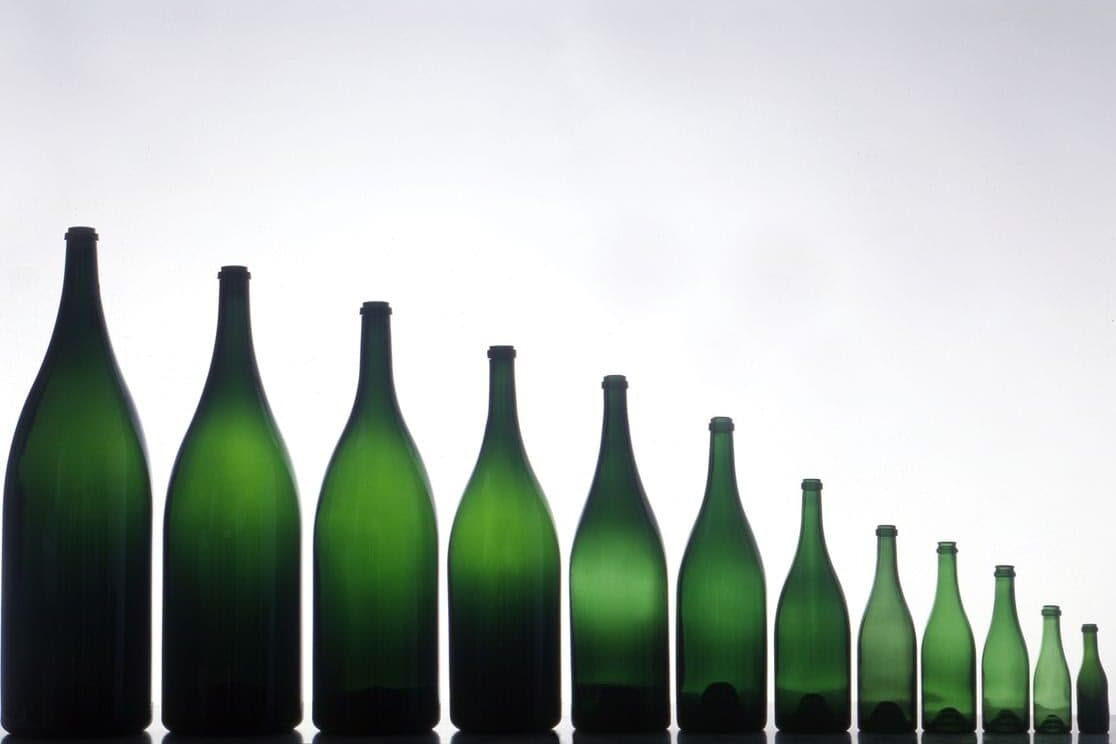
Wine Bottle Sizes
Although the 750 ml bottle is the global standard, several official bottle sizes exist.
| Name | Volume |
|---|---|
| Split or Piccolo | 187.5 ml |
| Half Bottle | 375 ml |
| Standard Bottle | 750 ml |
| Magnum | 1.5 L |
| Jeroboam | 3 L |
| Rehoboam | 4.5 L |
| Methuselah | 6 L |
| Salmanazar | 9 L |
| Balthazar | 12 L |
| Nebuchadnezzar | 15 L |
Why Are Magnum Bottles So Popular?
A Magnum contains the equivalent of two standard bottles.
Benefits
- Slower wine evolution
- Better aging potential
- More stable temperature
- Greater visual impact
For these reasons, many winemakers consider the Magnum one of the ideal bottle formats for wine aging.
Does Bottle Color Matter?
Yes.
Glass plays an important role in protecting wine from light exposure.
Dark Glass
Most commonly used for:
- Age-worthy wines
- Premium wines
- Bottles intended for long-term cellaring
Advantage
Provides better protection against ultraviolet radiation.
Clear Glass
Frequently used for:
- Rosé wines
- Young wines
- Products with strong visual appeal
Advantage
Allows consumers to easily appreciate the wine's color.
Summary of the Main Wine Bottle Types
| Bottle Type | Main Characteristic | Common Wines |
|---|---|---|
| Bordeaux | High shoulders | Cabernet Sauvignon, Merlot |
| Burgundy | Rounded body | Pinot Noir, Chardonnay |
| Alsace/Mosel | Tall and slender | Riesling, Gewürztraminer |
| Champagne | Thick reinforced glass | Sparkling wines |
| Provence | Elegant curved design | Rosé wines |
Conclusion
A wine bottle is far more than just a container.
Its shape, closure, color, and size are the result of centuries of technical and cultural evolution. The high shoulders of a Bordeaux bottle help manage sediment, Champagne bottles withstand substantial internal pressure, the punt increases structural strength, and screw caps offer a modern and highly effective alternative to traditional cork closures.
The next time you open a bottle, take a moment to appreciate it with the same attention you give to the wine it protects.